Yellow, orange surprise as best paint colors for <b>car</b> resale value <b>...</b> |
| Yellow, orange surprise as best paint colors for <b>car</b> resale value <b>...</b> Posted: 22 Jun 2014 04:28 PM PDT 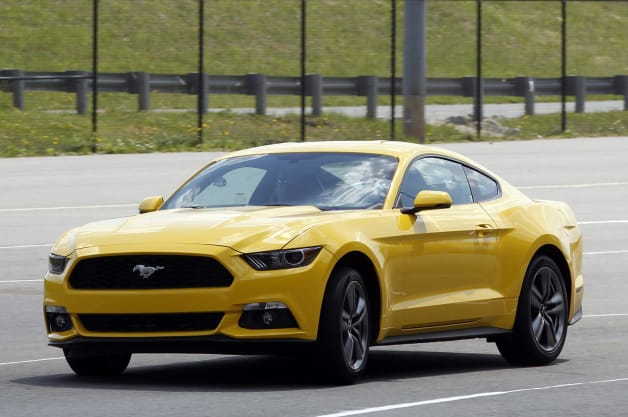 It might be worth choosing a color other than the standard black or silver next time you're car shopping. A new study conducted by the used car search engine iSeeCars.com of over 20 million previously owned vehicles last year finds that less popular shades lead to lower price depreciation than the usually more favored hues. Yellow and orange show the lowest price drop in the analysis versus black, gray and silver with the biggest dives. The difference isn't just a few dollars, either. Yellow cars depreciate 26.2 percent on average from their original MSRP over 5 years (adjusted for inflation), compared to 34.4 percent for a black vehicle. For example, for a typical $40,000 model, with all else being equal except for color, the yellow one loses $10,480 of its value over the half decade, and the black one drops $13,760 from its initial purchase price. iSeeCars.com CEO Phong Ly speculates that the difference may be down to simple supply and demand. With new vehicles, the price of different colors is all about the same (unless you opt for a special paint), but the used market can more freely adjust price depending on the variables. Ly claims that only 1.1 percent of the cars on the road are yellow or orange. Therefore, it makes some sense that there's a premium for them over more common colors. The study asserts that the results are true regardless of vehicle type. So if you're really trying to maximize your purchase and don't mind being a little bit different on the road, it might be worth considering a rarer color for your next purchase. Scroll down to read more about the study and see a full table of the shades by depreciation. Show full PR text Yellow Color Cars Depreciate Less Than Black Color Ones According to iSeeCars Study June 16, 2014 Woburn, Mass. (June 16, 2014) – Contrary to conventional wisdom, iSeeCars.com's study shows less popular car colors such as yellow and orange have lower depreciation than the most popular colors like silver and black. Yellow color cars show the least depreciation at an average of about 26% over 5 years from original MSRP (adjusted for inflation) while black has the highest at about 35%. For a vehicle with an MSRP of $20,000, that means on average, a yellow color one could be worth $1500 more at year 5 than the average car with average depreciation.
"While a popular car color like black or silver may get more interest and sell faster, our analysis indicates it may not get as high a value as a car, say, in yellow," Phong Ly, CEO and co-founder of iSeeCars.com said. "Scarcity may account for the difference - only 1.1% of all cars are yellow and orange; if teal and green are included, the percentage still goes up to just 5%. The dearth of supply of such colors may drive prices up." iSeeCars.com analyzed over 20 million used cars of all different colors from model year 1981 to 2010. The depreciation was calculated for each car and color based on its original MSRP (adjusted for inflation), its used car listing price, and the age of the vehicle. The lower depreciation of less common colors is seen across all car types including convertibles, coupes, sedans, SUVs, pickup trucks and wagons. For example, amongst SUVs, yellow color ones on average show the lowest depreciation. Amongst convertibles, teal adorned ones depreciate the least. As for more common colors like black, silver, or gray, the depreciation is closer to the overall average depreciation for a car of about 34% over 5 years. Methodology: About iSeeCars.com:  | ||||||||||||||||||||||||||
| 2015 BMW X5 Review, Ratings, Specs, <b>Prices</b>, and Photos - The <b>...</b> Posted: 19 Jun 2014 07:44 AM PDT A year after its redesign, the 2015 BMW X5 remains a benchmark in the luxury mid-size SUV segment. It's engineered by the Germans and built in South Carolina, and the X5 continues to offer excellent on-road manners and impressive off-road capabilities–all wrapped in a comfortable, luxurious family wagon that feels well-suited to gated-community garages everywhere. The X5 can seat up to seven, and for most of those passengers, it's a warmer ambiance to soak up. Seat comfort isn't perfect, though, with some flatness in the front buckets. The second-row seat in the X5 can now be split 40/20/40, for more flexibility, and they're adjustable for rake. If you get the optional third-row seats, there's separately a new Easy Entry function--but they're still Oompa-Loompa small, making them occasional seats at best, cargo space more often, a line-item veto most of the time. The cargo hold can be opened from the keyfob or the driver's seat: the lower piece drops like a truck tailgate, while the upper glass powers open like a minivan tailgate. No crash-test data has been published, but the X5 should equal its prior safety ratings. Active-safety features are heavily represented on the long, long options list. New features include the Active Driving Assistant (Lane Departure Warning, and a pedestrian collision system with braking), plus ACC Stop & Go (full-range camera-radar cruise control), and a new Traffic Jam Assistant that maintains following distance and keeps the vehicle at the center of its lane by providing steering input. BMW Night Vision and a head-up display remain on offer, as well as a Parking Assistant, Surround View system, and Active Blind Spot Detection. The X5 hasn't dramatically changed its sheetmetal in this generation, but the cabin's reworked handsomely. The new X5 is more gracefully sculpted than its ancestors, in measurable amounts but not in any dramatic fashion. There's plenty of X3 down the sides, where the tapered roofline and lower beltline nudge it gently toward a more sport-wagon-like form. The proportions make more visual sense, though it's not a huge transformation on the order of, say, the first- and second-generation Cayenne. In the cockpit, the monolithic bulge of BMW's latest dash designs shows up in swell form, made distinctive this time with a choice of neutral and brown leathers over the standard black leatherette. It's not so broad a palette until you reach into the more extreme colors on the option list. There's even a reddish-brown.The BMW X5 occupies that performance space typical of German SUVs like the Mercedes M-Class and VW Touareg and, yes we're going there, the Jeep Grand Cherokee. There's diesel power available, insanely plush spin-offs with V-8 thrust, sophisticated all-wheel-drive systems that provide moderate amounts of off-road capability, and extravagant suspension systems meant to muddle the crossover roots enough to make it more than palatable on-road. The familiar 300-horsepower, 3.0-liter, twin-turbo, in-line six-cylinder engine is the base engine, good for 0-60 mph times of about 6.2 seconds. We've yet to drive it, but have spent half days in the spiffy new xDrive35d turbodiesel and the V-8-powered xDrive50i. If 0-60 mph times rule, the V-8's 4.9 seconds bests the diesel's 6.9 seconds--but in our estimation, the diesel's fuel economy and torque in-town feel more than makes up for the two seconds of slack. All X5s now have electric power steering with adjustable effort and an Eco Pro mode that also affects the eight-speed automatic's shifts and throttle progression, even adaptive damper settings when they're onboard. The X5 feels most BMW-like only when Sport and Sport+ modes are engaged: there's a heft to the steering, a resolute resistance to body roll that only gets more defiant if it's outfitted with M Adaptive controls and a set of rear air springs. It's all but ready to transform into an X5 M, once all the electronics are plugged in--a reality that echoes how the X5 can feel from behind the wheel, what with the lack of steering feedback and the artificial counterdamping applied by the available active-roll stabilization system. The BMW X5 carries a base price of nearly $54,000, in line with other European-badged luxury SUVs. At the price, it's still without a few features we think should be standard--and are standard on some mass-market utes. A rearview camera is a $400 option; any color other than flat white or flat black brings a $550 upcharge; and leather upholstery costs $1,400 at minimum. Navigation is standard equipment on most versions; it comes with the iDrive controller with its new touch-write surface, and BMW Apps, a connectivity suite that runs via an iPhone app. (Android users: give it a few months.) If you want all-wheel drive, you'll need to step up into the X5 xDrive35i, which is priced from just over $56,000. In the $70,000 and up range, the X5 V-8 can be trimmed out with Dakota leather, Bang & Olufsen audio, a rear-seat entertainment system, and more. Our pick? Probably the winning turbodiesel five-seat model, lightly equipped with surround-view cameras and navigation, for the best long-term value of the lineup. |
| You are subscribed to email updates from car prices - Google Blog Search To stop receiving these emails, you may unsubscribe now. | Email delivery powered by Google |
| Google Inc., 20 West Kinzie, Chicago IL USA 60610 | |

No comments:
Post a Comment