New Cuban Law Allows <b>Car</b> Purchases, But <b>Prices</b> Are Sky High <b>...</b> |
- New Cuban Law Allows <b>Car</b> Purchases, But <b>Prices</b> Are Sky High <b>...</b>
- United States <b>Car</b> Travel Fuel <b>Costs</b> and Averages | The Energy <b>...</b>
- Tesla Motors aims to keep next <b>car's costs</b> down | Digital Trends
| New Cuban Law Allows <b>Car</b> Purchases, But <b>Prices</b> Are Sky High <b>...</b> Posted: 01 Jul 2014 06:10 AM PDT Cuba's 11 national car dealerships sold just 50 cars and four motorcycles in the first half of the year under a new law that removed limits on auto purchases for the first time in half a century. Cubans had welcomed the new law which removed limits on auto purchases, but many are in sticker shock at the 400-percent markup. Cuba has said it would invest 75 percent of the sales' proceeds for its public transportation system, but total sales at the country's dealerships reached just $1.28 million. A Peugeot dealership in Havana was pricing its 2013 model 206 at $91,000 when the new rules came into effect, and it wanted $262,000 for the sportier 508. Most state workers make around $20 a month. In 2011, Cuba started allowing people to buy and sell used cars from each other. Before then, only cars that were in Cuba before the 1959 revolution could be freely bought and sold, which is why there are so many U.S.-made, vintage 1950s cars on the streets. --Reuters IN-DEPTH: U.S. Cubans Soften Stance on U.S.-Cuba Relations Cuba Proposes New Law to Attract Foreign Investment First published July 1 2014, 6:58 AM  |
| United States <b>Car</b> Travel Fuel <b>Costs</b> and Averages | The Energy <b>...</b> Posted: 04 Jul 2014 07:00 AM PDT
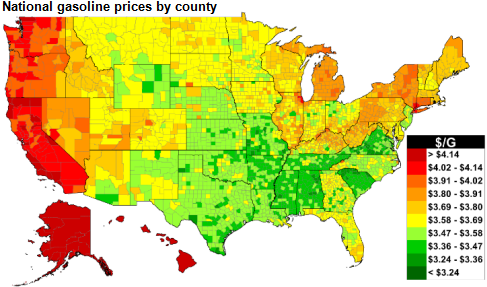
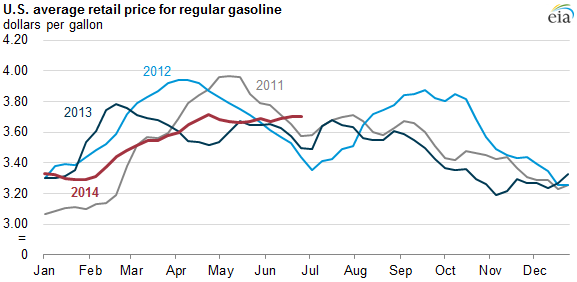
Source: Provided by GasBuddy.com On Monday, June 30, the national average retail gasoline price was $3.70 per gallon. Although this is the highest average heading into the Fourth of July holiday since 2008, gasoline prices in 2014 have remained well below the spring peaks reached in each of the previous three years (see graph). Although prices are currently 20 cents per gallon higher than last year at this time, prices this year did not peak as high as in recent years because of relatively stable crude oil prices in 2014. The peak retail gasoline price this year was $3.71/gal on April 29, lower than last year's spring peak of $3.78, and lower than price peaks in 2011 and 2012.
Source: U.S. Energy Information Administration, Gasoline and Diesel Fuel Update So far this year, the average price of gasoline has been $3.54/gal, the lowest for the first six months of the year since 2011. Since April, the increase in wholesale gasoline prices is lower (in percentage terms) than the recent increase in crude oil prices: 3.5% for gasoline compared to 7.2% for North Sea Brent. Typically during this time of year, petroleum refineries return to service from seasonal maintenance outages, which tends to lower wholesale product prices, including gasoline. This year, crude oil prices have increased in part because of unrest in Iraq, a major crude oil producer. These factors have largely offset each other, leaving retail gasoline prices relatively unchanged. World crude oil prices have fallen by $4 per barrel from a 2014 peak of $115 per barrel on June 19. If sustained, this should help bring gasoline prices down in the coming weeks. Principal contributor: Tim Hess  Connect: Authored by: U.S. EIA: Today in EnergyThe U.S. Energy Information Administration (EIA) collects, analyzes, and disseminates independent and impartial energy information to promote sound policymaking, efficient markets, and public understanding of energy and its interaction with the economy and the environment. EIA's Today in Energy offers topical, timely, short articles with energy news and information you can understand and use. ... Would you like to contribute to this site? Get started » |
| Tesla Motors aims to keep next <b>car's costs</b> down | Digital Trends Posted: 01 Jul 2014 10:15 AM PDT Tesla is preparing its third-generation electric car, and this time (relative) affordability will be as important as performance and technology. The car will have very little in common with the Model S and upcoming Model X crossover Chris Poritt, the company's vice president of engineering, told Autocar. It's all about keeping the cost down. The car formerly known as Model E (Tesla dropped that trademark a few months back) will compete with the BMW 3 Series, and that means it has to be more than a shortened Model S. Or rather, less. It will do without the Model S' aluminum chassis, likely going with steel instead. Tesla will also try to keep costs down with its massive battery "Gigafactory", which will build lithium-ion cells on a large enough scale to keep prices down. Tesla previously quoted a target price of around $40,000 for this latest model, with a range of around 200 miles per charge. It should also significantly increase Tesla's sales volume, just as the small luxury sedans from U.S., German, and Japanese carmakers form a broad base for their respective brands. However, unlike the predominant trend of familial styling seen among those other cars, the Tesla probably won't look like a shrunken Model S. Tesla design chief Franz von Holzhausen previously said Tesla won't do a "unit face" for all of its cars. Considering how different the entry-level Tesla may be under the skin from the Model S and Model X, that would be fitting. Whatever it ends up looking like, this model likely won't appear before 2016. In the meantime, Tesla is expected to launch the Model X next year. |


| You are subscribed to email updates from car prices - Google Blog Search To stop receiving these emails, you may unsubscribe now. | Email delivery powered by Google |
| Google Inc., 20 West Kinzie, Chicago IL USA 60610 | |

No comments:
Post a Comment