Monday, 31 March 2014

Tax Refunds, Easy Credit Boost Used Car Prices | The Truth About ...

Tax Refunds, Easy Credit Boost Used <b>Car Prices</b> | The Truth About <b>...</b>


Tax Refunds, Easy Credit Boost Used <b>Car Prices</b> | The Truth About <b>...</b>

Posted: 10 Mar 2014 06:42 AM PDT

145640_cars_KJH_

A combination of income tax refunds issued in January and February with accessible financing have boosted used-car prices overall in the first two months of 2014.

Automotive News reports prices rose 1.1 percent year to date, and 0.8 percent over the past month, according to the Manheim Used Vehicle Value Index. Meanwhile, the IRS processed 40.4 million returns in the first two months of the year, refunding $125.8 billion to taxpayers at an average of $3,112, which helped in propping up wholesale used vehicle prices.

Easy credit with attractive terms also aided used-vehicle pricing, making the market "more profitable than the underlying unit sale numbers would suggest" according to Manheim.

Overall sales fell 1 percent from the previous year, and 12 percent from January to 2.05 million units, with used compact cars falling the hardest at 3 percent from last year due to heavy supply and competition from newer vehicles. Used truck sales rose 8 percent in the same period due to high demand and low inventories.

Sunday, 30 March 2014

1st Tesla battery-swapping stations to roll out soon, Model S prices ...

1st Tesla battery-swapping stations to roll out soon, Model S <b>prices</b> <b>...</b>


1st Tesla battery-swapping stations to roll out soon, Model S <b>prices</b> <b>...</b>

Posted: 24 Mar 2014 04:34 AM PDT

Elon Musk, CEO and Chief Product Architect of Tesla Motors, has said that Tesla will roll out its first battery-swapping stations within the "next few months."

A Tesla battery-swapping station, you might recall, was unveiled back in June 2013 at a demo in California. Tesla crew showed at the time that they could swap out a battery in about 90 seconds, faster than it took a colleague to fill up his Audi at a nearby gas station. Here's the video if you missed it:

The first battery-swapping stations were supposed to roll out by the end of 2013, but I guess we can give Tesla a little slack. It's been working on plans for a gigafactory, getting the Model X ready for launch, getting deliveries of the Model S to Europe and China going, rolling out Superchargers across Europe, and fighting auto dealer associations in New Jersey, Texas, and elsewhere.

The first "few" Tesla battery-swapping stations will be in California, between Los Angeles and San Francisco. Elon stated that Tesla would evaluate how they do before deciding to roll out battery-swapping stations elsewhere.

In other Tesla news, the price of the Model S has dropped in a few European countries. In Germany, the starting price has dropped by about 7,000 euros (~$9,650), down to 65,300 euros (~$90,100). In the Netherlands, the starting price has dropped by 4,000 euros (~$5,500), down to 66,200 euros (~$91,200). While no reason was given, speculation has ranged from lower-than-anticipated sales to a simple update based on changes in currency exchange rates. I also wouldn't rule out the possibility that logistics for sales in Europe have been smoothened out and better economies of scale achieved, so Tesla is adjusting prices down accordingly. Elon has said repeatedly that the Model S would earn Tesla the same profit per car overseas as it does in the US, and that the higher prices are only from adding on unavoidable costs related to shipping, taxes, duties, etc.

Notably, Tesla anticipates sales in Europe and China to be about double what they are in the United States by the end of the year.

Saturday, 29 March 2014

Used Luxury-Car Prices Continue Slide in March - KickingTires

Used Luxury-<b>Car Prices</b> Continue Slide in March - KickingTires


Used Luxury-<b>Car Prices</b> Continue Slide in March - KickingTires

Posted: 27 Mar 2014 06:56 AM PDT

2011-chevrolet-volt

Models from luxury brands accounted for seven of the top 10 used cars with the biggest price drops in March. That's the same number of luxury brands we saw on the list last month. Overall used-car prices held mostly steady in March, down just $6 to an average of $23,243.

Used Luxury-Car Prices Drop Most in February

Luxury brands had the majority of cars on the list, but the Chevrolet Volt extended-range electric car experienced the biggest price drop. It was down 3.1 percent ($811) to $25,000. This winter has not been kind to used Volt prices, which are down 10.5 percent ($2,922) since Dec. 1, 2013.

Among cars with the biggest price gains, the Ford E-250 Super Duty full-size van led all models for the second month in a row. It was up 2.6 percent ($548) to $21,946. Most of the models in the top 10 were cars and trucks from mainstream brands, but one luxury car — the Mercedes-Benz SL-Class roadster — made the list with a 1.9 percent ($1,536) increase to $82,138.

The charts detail used cars from the 2011 to 2013 model years with the biggest price drops — as well as those with the biggest gains. To be eligible for the lists, a model had to have at least 250 cars in Cars.com's national inventory.

FINAL-UsedCarPricesDown

FINAL-UsedCarPricesUP

Cars.com photo by Evan Sears

Tesla Motors to Reduce <b>Price</b> Tags Over the Next 3 Years

Posted: 26 Mar 2014 06:55 PM PDT

Tesla Motors

During the past year, the share price for Tesla Motors (TSLA) has climbed surely and steadily, but has hit a ceiling in the wake of recent events. The high-end electric car manufacturer has been banned from selling their cars in Texas and New Jersey, and litigation to ban the company is taking place in New York and Ohio. This could potentially put a huge dent in Tesla's quarterly sales figures. Along with these setbacks, Tesla Motors is seeking to reduce the price tags on each model of their cars over the next 3 years.

Automobile manufacturers have pitted themselves against Tesla Motors and their sales methods. Tesla sells cars directly to customers with no dealership involved. A customer simply pays what Tesla asks for the car, and there is no bargaining process. Nobody makes a commission for the sale of a Model-S, which Tesla sells with a price tag of $69,000.

The sales dilemmas in Texas, New Jersey, New York, and Ohio have not phased Tesla Motors a bit. They are still committed to a general 3 year plan resulting in the construction and sale of over 500,000 cars per year. They project that their Model-S could be reduced in price from $69,000 down to $30,000 or $40,000. Tesla is currently negotiating with various states to construct their "Gigafactory," a $5 billion dollar lithium-ion battery construction facility. It is estimated that Tesla Motors will use this facility to reduce the price tags of each model by dropping the unit price of each battery to less than half of the current price.

Shareholders in Tesla Motors have been reluctant to take part in the company's enthusiasm during the first quarter of 2014. The share price has dropped 44.56 points from $265.00 down $220.44 during February and March. The consensus among shareholders seems to be that the company won't be able to sustain their high sales figures as more states ban their direct sale method. Tesla continues to remind shareholders that they have sold every car produced so far, and they continue to project ever-increasing sales figures.

Judging from the way shareholders are handling the Tesla situation at the moment, it is probably safe to assume that the share price may wobble around for a while. The first quarter sales figures may put investors at ease, but the continued banning of all car sales in new states seems to have investors pulling their hair out. As it stands now, the "Gigafactory" is still on the drawing board, and the company's current goal is to double their sales figures from 22,477 cars sold in 2013 to hopefully more than 40,000 in 2014.

The plan from Tesla Motors to reduce the price tags on their cars over the next 3 years may not garner any enthusiasm from investors. As the car maker reduces prices and more states ban car sales, investors see a trend that may drastically reduce revenue. Tesla may have lofty goals of mass-production, but there is little evidence to suggest that they will get there. To top things off, the car company does not seem to be properly dealing with the sales bans in New Jersey and Texas. It looks like the downtrend in share price may continue into the second quarter of 2014.

By Luke Sargent

Sources

The Wire
Forbes
CNN Money

Tuesday, 25 March 2014

5 Surprisingly Valuable Classic Cars | Bankrate.com

5 Surprisingly Valuable Classic <b>Cars</b> | Bankrate.com


5 Surprisingly Valuable Classic <b>Cars</b> | Bankrate.com

Posted: 13 Mar 2014 05:00 PM PDT

auto

While some classics cars just shout "expensive," there are quite a few sleeper collectible cars that have eye-popping values. Hagerty Insurance, which insures classic cars, identified five such cars and provided us with a range of prices, depending on condition. In this story, low prices represent classic cars that are in fair condition, while those commanding top prices would be for cars worthy of winning an award at a major classic car show.

For the best auto loan rates, go to Bankrate.com.

IMC reduces <b>car prices</b> up to Rs 75,000 | Pakistan Today

Posted: 21 Mar 2014 11:39 AM PDT

Indus Motor Company Limited (IMC), the manufacturer and distributor of Toyota range of passenger cars and commercial vehicles, announced a substantial reduction in prices of their products by up to 75,000 rupees. Following the recent strengthening of Rupee against the US Dollar, IMC has taken the initiative of passing on the benefit of strengthening rupee to the customers.

Recently, the Pak Rupee has strengthened in value due to government's efforts in wake of ministry of finance's commitment to stabilise the rupee.

Ali Asghar Jamali, the IMC Chief Operating Officer, hailed government's efforts in this respect and said: "We appreciate the government of Pakistan's move to stabilise the rupee in such challenging times. The ministry of finance pledged to stabilise the rupee and have delivered their promise. We are very grateful to Finance Minister Ishaq Dar for delivering on his promise. As an organisation committed to delighting customers, we are immediately passing on the accrued benefits to our customers. Earlier this year, we reduced the prices of our Corolla Xli Standard by around 89,000 rupees  and now, we have yet again, taken an industry first initiative of reducing the prices by up to 75,000, he said.

He further stated that the IMC had always put the interest of consumers at the forefront and they aimed to provide quality products at the most affordable prices in Pakistan. "Our localization efforts are directed towards making cars more affordable for the domestic customers".

The subject price reduction comes at a time when costs of doing business are rapidly increasing due to energy crisis and law and order situation that drives up security costs and risks.

"The full benefits of the strengthening rupee have yet to set in for the industry, however, due to our customer first code, we are immediately passing on the benefits to the consumers", he added.

The prices for Xli/Gli variants have been reduced by 50,000 rupees and prices of Altis variants have seen a reduction of Rs 75,000. Similarly, the prices of Hilux range of pickups have been reduced by 10,000 to 30,000 rupees.

Sunday, 23 March 2014

Countries and Electric Car Usage and Growth | The Energy Collective

Countries and Electric <b>Car</b> Usage and Growth | The Energy Collective


Countries and Electric <b>Car</b> Usage and Growth | The Energy Collective

Posted: 22 Mar 2014 05:00 AM PDT

EV wedge

Have you ever heard of the EV Wedge?

No? Me neither. Let's try to define it then.

If you'd asked me to define the 'Electric Vehicle Wedge' a few years ago I would have chuckled a little, and suggested it was the small pile of cash you needed to afford one.  But due to falling EV prices and rising gasoline prices that snark is utterly outdated.

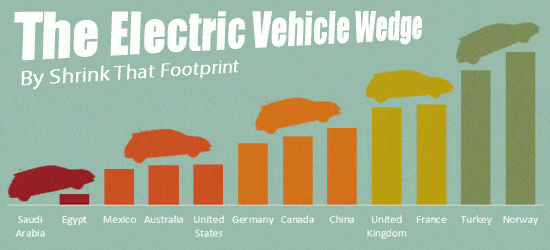
In almost all countries it is cheaper to power an electric vehicle than fuel a gasoline car.  The cost gap between these two fueling options is what I like to call the EV Wedge .  In some countries this wedge is so damn big that EV drivers can't sit straight for all the cash in their wallet.

Comparing Gasoline and Electric Fuel Costs

This post provides a cheap and cheerful comparison of fuel costs for electric vehicles and gasoline cars.  To keep it simple I thought we'd look at the costs of fuel for driving 10,000 miles.  This is about 25% less than Americans drive each year, or 20% more than Europeans.

The graph below compares the fuel costs of driving 10,000 miles in a Nissan Leaf (electric) and Toyota Prius (gasoline hybrid).  I've shown this graph first so we can see how the fuel savings are calculated.  It also shows us that both the electricity price and gasoline price are relevant when estimating the fuel savings.

Electric vs gasoline fuel costs

The first thing to note is that the fuel cost of driving a Prius is greater than the Leaf in all 12 countries we collected data for.  The variation between both electricity and gasoline prices across countries is enormous.

In countries where gasoline is expensive, like Turkey and Norway, the fuel cost for driving a Prius 10,000 miles is pushing $2,000 whereas in Saudi it is just $120.  The fuel cost of driving the Leaf 10,000 miles varies greatly too. From as high as $980 in Germany down to $116 in Saudi.

The difference between the gasoline and electricity costs is what I call the EV Wedge.  By showing this graph first we can see that in places like Germany and Australia high electricity costs can eat into the wedge.  Where electricity prices are high savvy EV owners look to solar, or time of use pricing, to drive down their charging costs.

The EV Wedge: Nissan Leaf vs Toyota Prius

In each of the last three months of 2013 the most popular new car in Norway was either the Nissan Leaf or Tesla Model S.  There are loads of reasons behind this, including no purchasing tax, free tolls and access to bus lanes.  On top of this the EV Wedge is enormous!!

Here's the data we looked at above but now purely looking at the fuels savings, the wedge that is.

EVwedgeprius

Over the course of driving 10,000 miles a Prius driver in Norway spends $1,544 more on fuel than a Leaf driver.  In Turkey that figure is $1,360, in the UK it's $986, in the US it's $410 and in Saudi it's just $5.  Just add a zero and you've got the fuel savings for 100,000 miles assuming constant prices (the problem with any lifetime comparison).

All the figures assume the typical combined fuel economy for each car and the 2012 average prices for gasoline and electricity in each country. In cases where the electricity used to charge is cheaper than the household grid average this figure will be greater.  This is actually a really important point because typically a majority of EV owners use off-peak charging when available.

In the comparison above we've compared two compact hatchbacks.  But the 50 MPG Prius is actually pretty damn efficient for a gasoline car.  The EV Wedge only gets bigger when you start comparing less efficient petrol cars to electrics.

The EV Wedge: Nissan Leaf vs Toyota Camry

I know that the Toyota Camry is a bigger car than a Leaf but I find this a fun comparison.  It is basically America's most popular electric car (the Leaf) against its most popular sedan (the Camry).  Unlike the Prius, the Camry only gets 28 MPG.  So the fuel savings from driving a Leaf are considerable.

EV Wedge Camry

When you compare the fuel costs of the Nissan Leaf to a less efficient petrol vehicle like the 28 MPG Camry they really start to stack up pretty quickly. Don't get hung up on it being an American Camry, these figures hold for any 28 MPG car gasoline car.

In European countries where taxes on petrol are high the savings from going electric are considerable.  The fuel savings of driving a Leaf instead of a 28 MPG petrol car in the UK are $2,260 for each 10,000 miles.  Even in the US where gasoline is relatively cheap there is a $1,000 saving.

Finally, just for a laugh let's run the numbers for some luxury cars.

The EV Wedge: Tesla Model S vs Mercedes

I know very little about luxury cars.  I'm not even sure if someone spending $100,000 on a car really cares much about fuel costs.  I'm guessing they love the Tesla because of the torque and the ride.  But then again I may be wrong.

You see the Tesla Model S has topped monthly sales in Norway twice recently.  Not just for electric cars, but for all cars. The tax exemption for buying is no doubt a big deal.  As is the ride.

But just check out these fuel savings for the Tesla Model S compared to the 19 MPG Mercedes 550S.

EVwedgetesla

Not only do Tesla Model S drivers enjoy the pleasure of driving the best car Consumer Reports have ever tested, but in Norway they'll be able to buy the next one using fuel savings from their first.

Throw in some very modest rises in petrol price over the next decade and a Norwegian Tesla driver will save more than the purchase price by the time they've driven 150,000 miles.  Even for places like the UK, France and Germany the figures are pretty impressive.

When you consider that Tesla offers free supercharging in many places you start to see why they have waiting lists. With free electricity the US fuel savings versus the 19 MPG Mercedes jump to $2,000 per 10,000 miles.  In the UK, France and Germany they go above $4,000.  In Norway and Turkey it's above $5,000.

Curiously I actually think the graph above will eventually be more important for the Pickup Truck market than it is for luxury cars. You see those numbers aren't far off what the sums might look like for a 'Tesla Truck' vs a Ford F-Series.  And while we may be a few years away from batteries cheap enough to justify electric trucks their potential for fuel savings is just colossal when you consider a F-150 gets 19 MPG.

What to make of the EV Wedge?

To keep this post a bit of fun I avoided delving into lifetime cost comparisons and the fuzzy assumptions they involve.  Instead I'm just trying to point out something that should be clear by now.  Powering a car with electricity is cheaper than fueling it with gasoline (unless you live in Caracas).

Here are some basic takeaways:

  • Gas prices are key: the higher the gasoline price the bigger your potential savings are.  This makes electric cars attractive in Europe.
  • Electricity prices also matter: the potential benefits of going electric can be eroded by high electricity prices.  Germany and Australia are good examples.
  • Fuel economy matters too: the poorer the fuel economy of the car you are switching from the bigger your fuel savings will be.  You can see this in the more than doubling of the wedge between the Prius and the Camry.

Because of the varying differentials between gasoline and electricity prices the fuel savings from going electric vary massively from place to place.  But in general the economics for electric vehicles just keep getting better.

If you're looking at buying an electric vehicle in a couple of years when prices drop some more there is something worth thinking about.  You see electric vehicles are a bit like solar was a few years ago.  There are currently some very attractive grants and tax breaks that take some pain out of the purchase price, and this means EVs look great from a lifetime cost perspective.

As battery prices keep falling and production scales increase there is a good chance electric cars will keep getting cheaper.  As prices go down and sales go up the current level of subsidy will make less and less sense for governments, just as it did for high feed-in tariffs with solar.  In fact in some places they already seem too attractive.

If I was in the market for an electric vehicle I'd be keeping a very close watch on my local EV grants, tax rebates or other incentives.

If I lived in Norway I'd be on a waiting list, because it would also cut a lot of carbon.

Thursday, 20 March 2014

Used Luxury-Car Prices Drop Most in February - KickingTires

Used Luxury-<b>Car Prices</b> Drop Most in February - KickingTires


Used Luxury-<b>Car Prices</b> Drop Most in February - KickingTires

Posted: 20 Feb 2014 02:55 PM PST

UsedLuxuryVehiclePricesDrop

Average prices for late-model used cars advanced slightly in February, increasing just $12 to $23,249 as of Feb. 1. Prices for used luxury models, however, were on the decline as seven of the 10 models with the biggest price drops were from the luxury class.

Study: Men Want Luxury Cars, Women Want Crossovers

The top five models with the biggest price drops were luxury models, and all saw their prices dip by more than 3 percent. The Cadillac DTS' price dropped the most, falling 3.6 percent ($1,025) to $27,634. Aside from the BMW X3 compact luxury crossover, which saw its price drop 3.3 percent ($1,233), all of the models in the top 10 were cars.

There were considerably more types of vehicles represented in the list of models with the biggest price gains, and they were mostly from non-luxury brands; just two luxury cars made this list. Leading all models with the biggest price increase was the Ford E-250 full-size van, which was up 2.9 percent ($605) to $21,398.

The charts detail used cars from the 2011 to 2013 model years with the biggest price drops — as well as those with the biggest gains. To be eligible for the lists, a model has to have at least 250 cars in Cars.com's national inventory.

DROP

INCREASE

Source: Cars.com used-car listings, 2011 to 2013 model years

Manufacturer photo

Is This Tesla Model S the World&#39;s Most Expensive Electric <b>Car</b>?

Posted: 18 Mar 2014 10:00 PM PDT


Cars $205K Tesla Model S by T Sportline

Published on March 19th, 2014 | by Jo Borrás

$205K Tesla Model S by T Sportline

There is no doubt that the Tesla Model S is a premium product that carries a premium price tag. While Tesla itself often quotes the "starting at" price for its Model S, however, at least one Tesla owner wanted to see just how high he could get the car's price by ticking all the options that were made available to him. The result? The $205,820 Tesla Model S shown here.

Now, to be fair, I should point out that nearly half of the cost of the $200K Tesla you see here comes from aftermarket upgrades made by a company called TSportline. Presenting themselves as a sort of "AMG for Tesla," TSportline claims to be "the world's first electric car accessory tuner specifically focusing on the Tesla Motors brand." And these people know a thing or two about jacking up a car. "We are a group of automotive enthusiasts with over 30 years of combined automotive accessory experience. Our passion is electric cars and the Tesla brand. We believe Tesla has provided us a pallet (sic) where we can enable each owner to individualize his or her Tesla."

Faulty grammar notwithstanding, it looks like the TSportline guys know what's what. You can see what the included TSportline upgrade options cost here …

Most Expensive Tesla Model S

… and note that their prices are actually fairly reasonable when compared to, say, RENNtech or Brabus, who offer similar visual and interior upgrades for Mercedes and Tesla-branded cars. If you can afford it, then, it might not be a bad price to pay for an utterly unique ride.

You can see more of the modifications TSportline made to this "most expensive Tesla Model S" in Gas2′s 15 image photo gallery, and let us know what you think of the car in the comments section at the bottom of the page.

Source: TSportline; More Photos: Gas2.

Print Friendly

Tags: , , , , , , , , , , , , , , , ,


About the Author

I've been involved in motorsports and tuning since 1997, and write for a number of blogs in the Important Media network. You can find me on Twitter, Skype (jo.borras) or Google+.


Back to Top ↑

Wednesday, 19 March 2014

Chevrolet Raises Prices on Corvette Because It Can – News – Car ...

Chevrolet Raises <b>Prices</b> on Corvette Because It Can – News – <b>Car</b> <b>...</b>


Chevrolet Raises <b>Prices</b> on Corvette Because It Can – News – <b>Car</b> <b>...</b>

Posted: 10 Mar 2014 10:24 AM PDT

March 10, 2014 at 1:24 pm by | Photography by Robert Kerian

2014 Chevrolet Corvette Stingray

2014 Chevrolet Corvette Stingray

Want a new Vette? It's going to cost you more. Why? Because Chevy thinks you'll be willing to pay for it. "Pricing for the 2014 Corvette has been increased due to demand," said GM spokesman Michael Albano. The hike of $2000 on both coupe and convertible models, which now cost $53,995 and $57,995, took effect on new orders taken after March 1, though Albano said that customers who placed their orders before March 1 will not be subject to the new pricing, even if they haven't taken delivery yet.

The price of the Z51 performance package, which brings 19-inch front/20-inch rear wheels, larger brakes, performance suspension, sticky summer tires, and more, also went up by $1200, to $4000.


Interest in America's most iconic sports car has always been high, but the Vette has been particularly hot since the C7 hit the road last fall, easily earning a spot on our 2014 10Best list. Even at the new higher price, though, the Corvette Stingray is a relative performance bargain, as evidenced by its comparison-test win over the Porsche 911 Carrera S.

2014 Chevrolet Corvette Stingray

2014 Chevrolet Corvette Stingray

Other Stories You Might Like


Tuesday, 18 March 2014

Average American Can No Longer Afford “Average-Priced” New Car ...

Average American Can No Longer Afford “Average-<b>Priced</b>” New <b>Car</b> <b>...</b>


Average American Can No Longer Afford “Average-<b>Priced</b>” New <b>Car</b> <b>...</b>

Posted: 11 Mar 2014 09:01 PM PDT

The price of the average Chrysler product rose 6.1% year-over-year in February, according to TrueCar.

New car prices have been rising rapidly in recent years, various studies showing that Average Transaction  Prices – what buyers actually pay after factoring in incentives and options – have hit record levels.  And that means that more and more American motorists are being priced out of the market.

The average median-income household can no longer afford to purchase the "average-priced" new car or truck in 24 of the country's 25 largest metro areas, according to a new study by the financial website Interest.com.  The exception is Washington, D.C., according to the study, which also found that in 16 cities, median family incomes fell at least $10,000 short of what it would take to buy the typical new vehicle.

Our Price is Right!

"Too many families are spending way too much on new cars and trucks," said Mike Sante, managing editor of Interest.com. "Just because you can manage the monthly payment doesn't mean you should let a $30,000 or $40,000 ride gobble up such a huge share of your paycheck."

The average new vehicle now goes for $32,086, according to Interest.com – which works out to a typical monthly payment of $633.  While the number quoted by other tracking services vary slightly, there's general agreement that prices are rising a good bit faster than the rate of inflation.  TrueCar.com puts the so-called ATP at $32,074 last month, an increase of $1,110, or 3.6%, from February 2013.

"Average transaction prices continue to rise and are at the highest levels for February in the past five years," noted TrueCar.

That's led to an increasing gap between what the average American can afford and what they have to pay to get a new set of wheels.

(February car sales hit by the big chill. Click Here for the story.)

Only in Washington, D.C. could the typical median-income household afford to buy the average new vehicle based on what is known as the 20/4/10 rule, which factors in a 20% down-payment, a four-year loan and insurance – all of which should not exceed 10% of a household's gross income.

(Justice Dept. launching investigation into GM switch recall. Click Here for the latest news.)

Using that formula, a typical Washington resident could afford to buy a vehicle priced at $32,531, with a monthly payment of $641.

Second-ranked San Francisco fell more than $4,000 short, with a maximum affordable purchase price of just $28,009, and a $563 monthly car payment.  In Boston, the third-ranked city, the average household could handle no more than a $26,669 purchase and a $520 monthly payment.

In bottom-ranked Tampa, the typical household doesn't even come close, at a recommended maximum purchase price of just $14,209, and a maximum monthly payment of only $280.

Most analysts blame fast-rising car prices as one of the key reasons why the auto industry is not expected to reach its previous sales peak of more than 17 million vehicles during this economic cycle.

It's also a factor that has led to a surge in sales of "certified pre-owned" vehicles, typically two- to four-year-old off-lease cars and trucks that have gone through intensive inspections and repairs and which are usually back with like-new warranties.

But motorists who still want the smell and feel of a new car continue to find ways, often by extending loans to five or six years, sometimes even longer. On the positive side, analysts note that automotive finance rates are currently at or near historic lows.

Few expect the upward trend in pricing to mitigate any time soon, however.  For one thing, manufacturers have been cutting back on the lush incentives they used to draw buyers into showrooms during the Great Recession. They're also passing on the increased cost of new mileage, emissions and safety regulations. And despite it all, consumers continue loading up their vehicles with ever more options that have helped push prices to record levels.

Tags: , , , , , , , , ,